
FIRST is bigger than any one robot.
FIRST (For Inspiration and Recognition of Science and Technology) is a global nonprofit founded in 1989 by inventor Dean Kamen. Its mission is to inspire young people to become leaders in science, technology, engineering, and math by giving them a hands-on, mentor-guided robotics experience instead of a textbook one.
FIRST runs a ladder of programs by age, stepping up in engineering complexity as students get older. We compete in FIRST Tech Challenge (grades 7-12), and older students can go on to FIRST Robotics Competition, building full-size industrial robots.
Every program shares the same philosophy: compete hard, but help each other do it. FIRST calls this Gracious Professionalism® and Coopertition®—treating rivals with respect and succeeding without ever putting another team down.
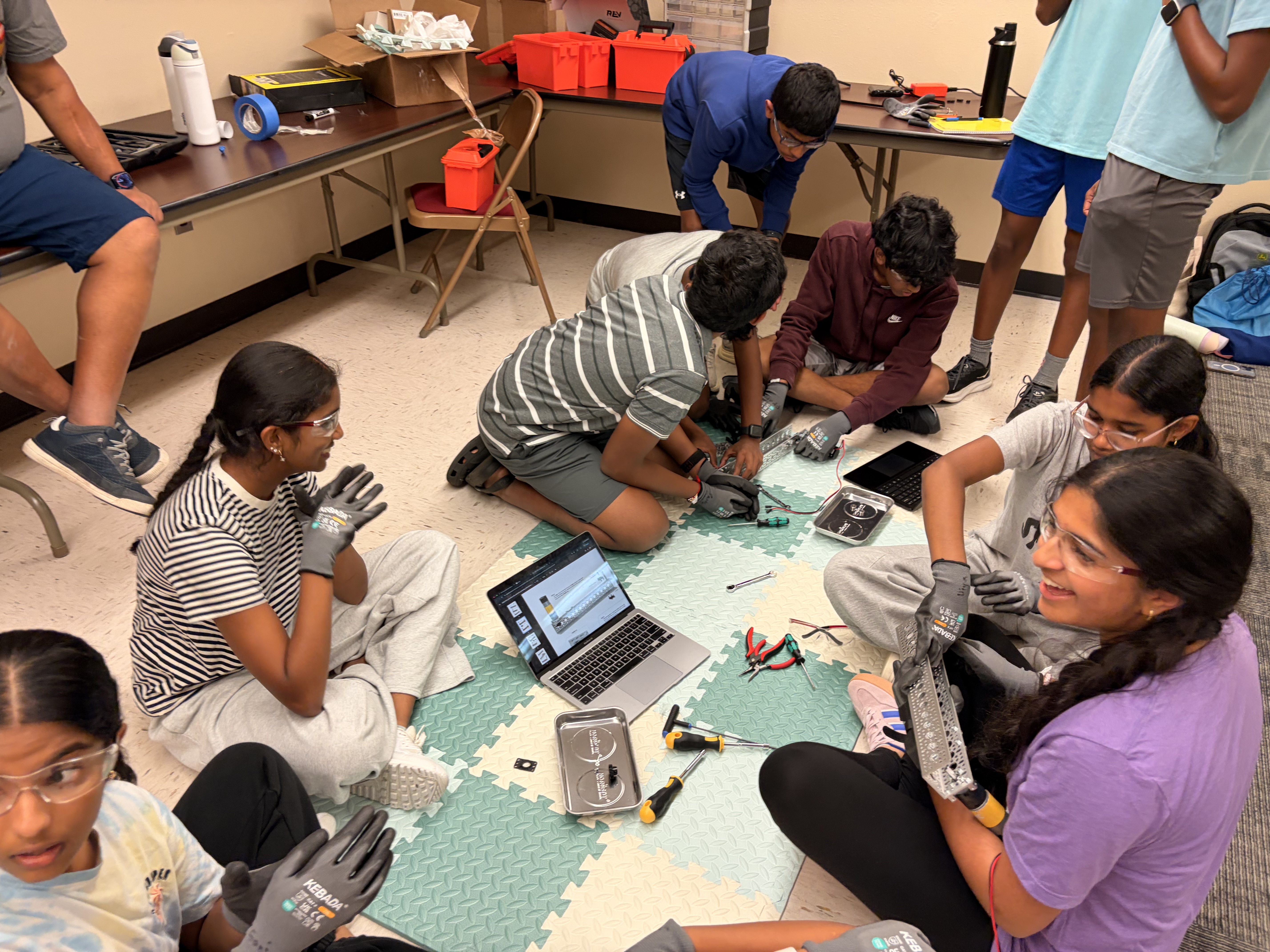 Learning by building, not just reading.
FIRST® CANOPY™: a season about biodiversity.
Every FIRST program is exploring how interconnected ecosystems in nature can inspire engineering—each with its own game built around that theme.
BIOBUZZ™ presented by RTX
BIOBUZZ, is the 2026–2027 FIRST Tech Challenge game, officially revealed during Kickoff on September 12, 2026. In BIOBUZZ, teams design, build, and program robots to compete in fast-paced matches focused on collecting, transporting, and delivering scoring elements around the playing field. Robots must work efficiently and strategically while balancing speed, precision, defense, and reliable game-piece handling.
The game features two primary scoring elements: Pollen and Nectar. Pollen consists of small, 3-inch balls that robots collect directly from the field and transport to scoring locations. Nectar consists of larger balls that are alliance-colored, adding an additional strategic element as teams work to collect and deliver the correct scoring elements for their alliance.
Each match begins with an autonomous period, where robots operate using pre-programmed instructions without direct driver control. Teams must rely on sensors, vision systems, carefully planned paths, and accurate mechanisms to score and position their robots effectively. After the autonomous period, the match transitions into the driver-controlled period, where team drivers take control of their robots and react to the changing conditions on the field.
Success in BIOBUZZ requires more than simply scoring as many game pieces as possible. Teams must develop robots capable of quickly acquiring Pollen and Nectar, moving efficiently around the field, and consistently delivering game pieces to their scoring locations. Alliance coordination, strategic decision-making, mechanical reliability, and effective software all play important roles in determining how teams approach each match. With a combination of autonomous strategy, driver skill, and robot engineering, BIOBUZZ challenges FIRST Tech Challenge teams to create innovative solutions while competing alongside their alliance partners.
Curious how we're tackling BIOBUZZ?
Meet the students designing and building our robot this season.